Ove Care
An AI-powered menstrual wellness platform. Not another calendar with extra steps. A companion that listens, learns, and responds with the warmth and accuracy the category has been missing. Flutter, Node.js, OpenAI. 18 weeks.
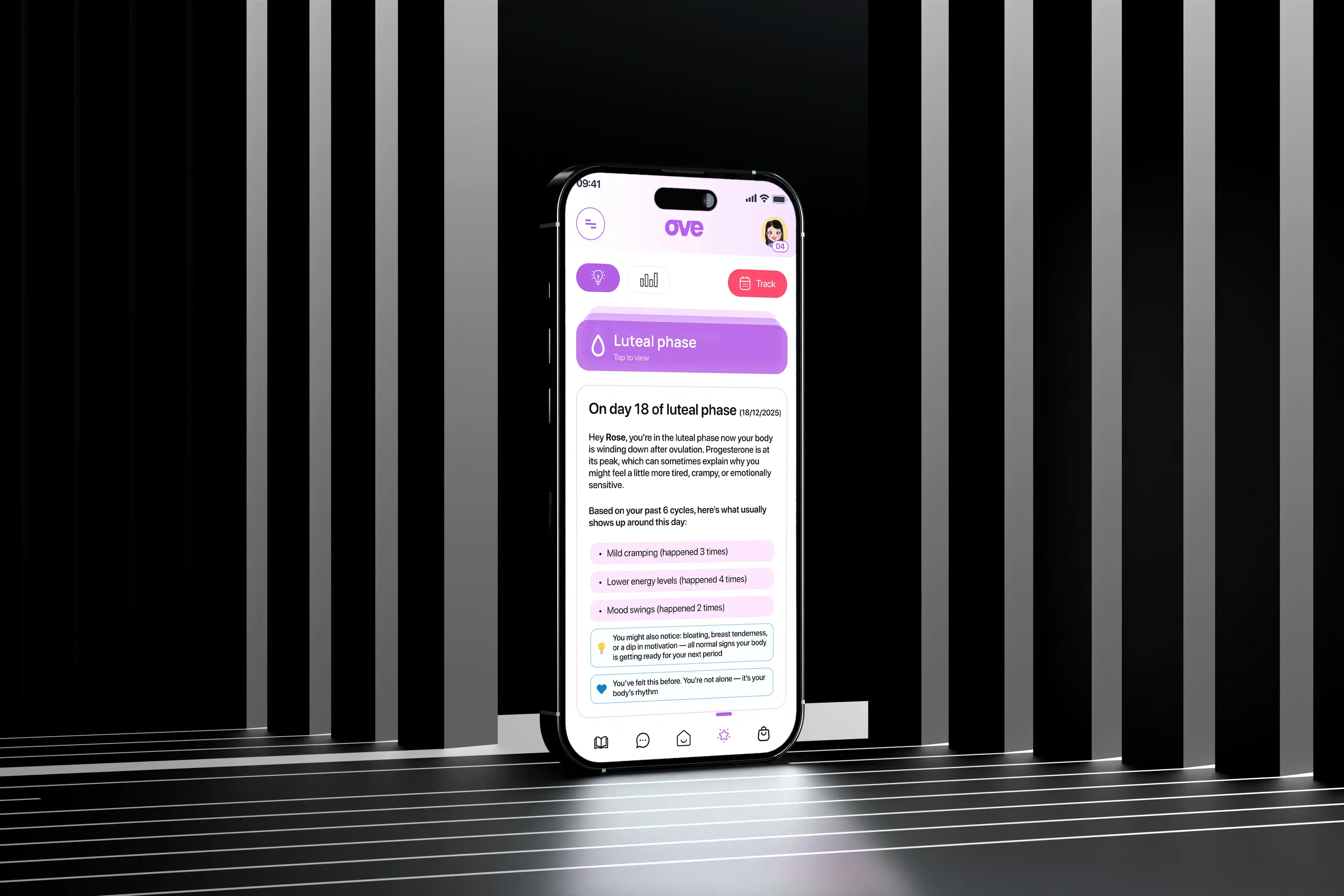
What We Delivered
The Situation
You open the app on a Tuesday morning because something feels off. You have been tracking your cycle for months. The app knows your dates. It has logged your symptoms. It has charted your mood in a colour-coded grid that is, objectively, quite pretty. But when you scroll through it looking for a signal, some pattern, some explanation for why today feels the way it does, there is nothing there. Just data. Raw, uninterpreted, unhelpful data. The app can tell you what happened. It cannot tell you why.
-
Tracking without intelligence
Most apps store symptoms without learning from them. A user who logs anxiety on day twenty-two has no way of knowing whether that is a pattern, a coincidence, or a symptom worth paying attention to. The experience ends where the user's need begins.
-
No emotional layer
Most apps treat tracking as purely functional. The user is a data entry point. The app is a database. The relationship between them feels transactional and cold.
-
AI accuracy in health context
Health-related AI output requires a different standard entirely. Plausible but wrong health information is worse than no information. "You may feel more energetic during your follicular phase" is not insight. It is a horoscope dressed in medical language.
-
No conversational support
When a user needed guidance about symptoms or patterns, there was nowhere to go inside the app. No conversation. No warmth. No response that felt like someone was listening.
-
Data privacy at health-grade standards
Menstrual health data is deeply personal. Architecture had to reflect this sensitivity from the data layer outward, not bolted on as an afterthought.
Most menstrual health apps are calendars with extra steps. Ove Care was built to be the part that comes after the data. The part that actually helps.
The Approach
Phase 1
Product Strategy and Wellness UX
Design focused on creating a wellness experience, not a medical interface. A design flaw in a health app does not just create friction. It creates mistrust. Fixing it in design is an hour's work. Fixing it in production is a sprint.
Wellness-first information architectureCycle data and AI insights structured as a wellness journey. The user should feel supported when she opens the app, not like she is reporting to a database. Every screen designed to communicate warmth before requesting input.
AI interaction designHealth insights delivered with appropriate confidence levels and clear boundaries. The AI never plays doctor. It acknowledges, it explains what patterns might mean, and it knows when to say "talk to a professional about this." That boundary sounds simple. Holding it reliably is the product.
Privacy-first data designWhat is stored, how it is stored, and who can access it, all determined by content sensitivity. Privacy built into the data architecture, not layered on top.
Phase 2
Flutter App and AI Integration
Flutter for cross-platform mobile. OpenAI integration with structured prompts ensuring accuracy, appropriate tone, and emotional warmth across every interaction.
Cycle tracking interfaceIntuitive tracking that captures enough data for AI analysis without creating daily friction. A user who finds tracking burdensome stops tracking. A user who finds it quick and gentle keeps providing the data the AI needs to become genuinely useful.
AI wellness insights engineOpenAI integration with structured prompts calibrated for accuracy and tone simultaneously. The AI learns from individual data across cycles, providing increasingly personalised insights. The difference between generic and personal is what makes a user feel heard.
Wellness chatbotA conversational interface that holds real conversations about symptoms, patterns, and how the user is feeling. Not a search engine dressed as a chatbot. A response system built to offer warmth when the user needs it and clarity when the user asks for it.
Phase 3
Backend and Data Architecture
Node.js with MongoDB Cluster, built for health data privacy, accuracy, and longitudinal personal data.
Health-grade data architectureMongoDB document structure designed for sensitivity. Every interaction auditable. Access controlled at the data layer. The database schema is not just a technical decision. It is a privacy commitment.
AI orchestration layerBackend managing prompt construction, context assembly, and response validation. The orchestration ensures the AI receives the right context for every response and stays within its defined boundaries.
Subscription architecturePremium and free tiers designed around genuine value, not friction. The premium experience offers something meaningfully better, not just less restriction on data the user already provided.
The Numbers
Ove Care launched as a platform that goes beyond tracking. A user who logs how she feels today receives insights that connect that feeling to her cycle, her history, and her patterns. The app does not just record. It responds.
Mohit's Take
"The most important decision was what the AI would not do. It would not diagnose. It would not prescribe. It would not play doctor. Defining those boundaries clearly was more important than any feature we built. In health AI, the guardrails are the product. We also spent considerable time on the emotional register of the chatbot responses. A user who tells the app she feels terrible on day twenty-two needs a response that sounds like it was written by someone who cares, not generated by a system that processed her input. Getting that tone right, consistently, across thousands of possible inputs, was the work that took the longest and mattered the most."
— Mohit Ramani, Founder & Lead Architect, Empyreal Infotech
Tech Stack
The toolchain behind the Ove Care platform.
Start a Conversation About Your Product
You are building a health or wellness product where AI needs to be accurate enough to be trusted, sensitive enough to be welcomed, and intelligent enough to be genuinely useful. The demo works. The question is whether the architecture will hold when real users arrive with real feelings and unpredictable inputs.
A discovery call with Empyreal is thirty minutes. You describe the product. Empyreal listens, asks the questions about safety, accuracy, and emotional design that determine whether the product earns trust or loses it, and gives you an honest read on what the build requires.